Running fake citizen voices with AI against critics is not a clever way to govern. If a state body did it, it would breach Indonesia's own constitution and a treaty Indonesia has ratified.
The argument
A state may answer its critics. It may not pretend to be the public while it does so. Accounts that present official or paid messaging as the independent opinion of ordinary citizens, in order to drown out, discredit or frighten critics, turn a right into a stage prop. The citizen speaks. The state replies in its own name. That is the line, and automation does not move it. Automation only makes crossing it cheaper, faster and harder to see.
What is documented
Evidence level for everything in this section: press report. Provisional.
- Harian Terbit reported in May 2026, citing Japanese media and Amnesty International research, that military-linked social media accounts ran disinformation campaigns against activists, and that critics were labelled "antek asing" (foreign agents). Source
- Kompas reported that some ministries and government agencies are said to use buzzer services, directly or through intermediaries. Source
- Officials have denied it. A presidential spokesperson of the previous government rejected the idea that the government uses buzzers to silence criticism. Source
What is not documented
As of 22 October 2026, Monsoon Ledger has found no published investigation, platform report or official document showing that Indonesian state bodies use AI models such as Claude or GPT to run these accounts. This page does not claim it. It sets out the test that such conduct would have to pass, and could not.
A screenshot that circulated, and why it is not evidence
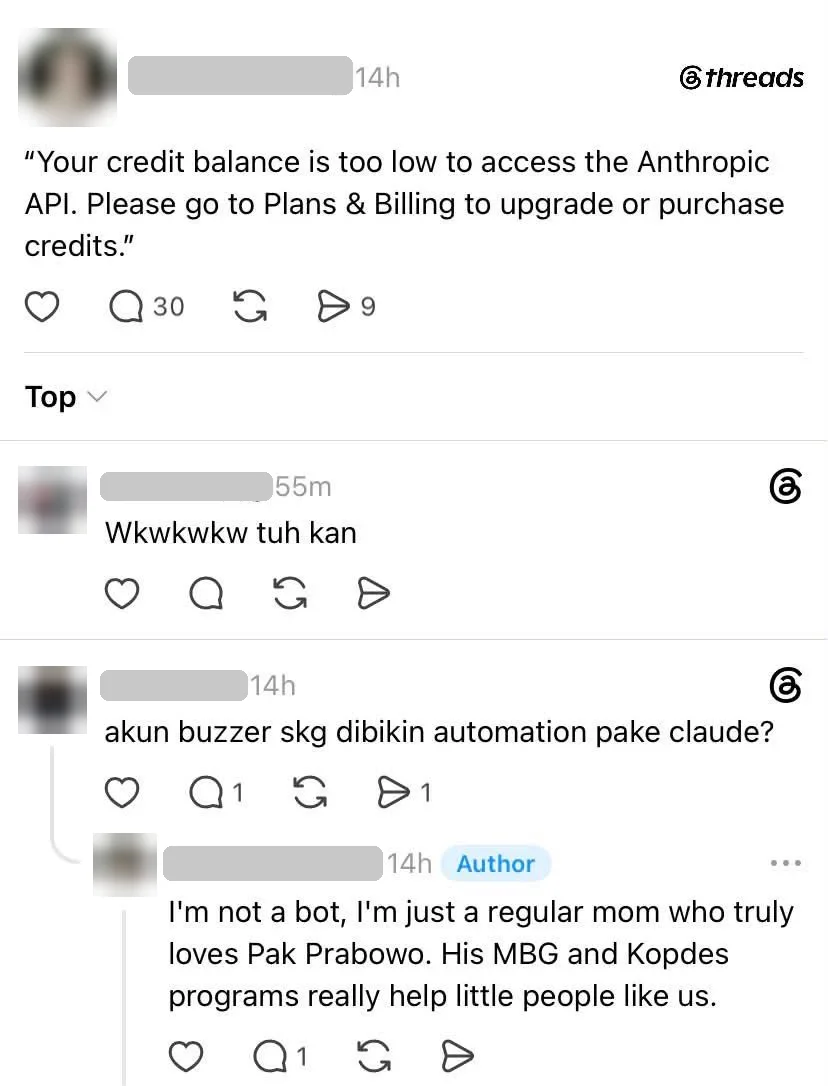
In October 2026 a screenshot spread on X showing a Threads post whose entire text was a billing error from the Anthropic API, the same message developers report when an account runs out of credit (example). A commenter asked whether buzzer accounts are now automated with Claude. The account replied, in English, that it was not a bot.
What it shows. If the screenshot is genuine, some software connected to an Anthropic API key posted the error to that account instead of a written message.
What it does not show. Who runs the account, whether anyone paid for it, whether it belongs to a network, or any link to a government body. The original post has not been authenticated, and a screenshot can be edited. Under the verification protocol, content like this is a lead, never evidence.
Provenance. The link to the post on X is kept on file and not published, because the original image shows the account holder's face and name.
Why it is here. It shows why the question on this page is not hypothetical. A single account can leak an AI provider's error message, and the same tools can run thousands of accounts. Whether any state body does this is exactly what the evidence does not yet show.
The legal test
- The constitution. Article 28E(3) of the 1945 Constitution protects the freedom to express opinions. Article 28F protects the right to communicate and to seek and share information. Article 28J(2) allows limits only by law, and only for named purposes in a democratic society.
Original, Bahasa Indonesia
“Setiap orang berhak atas kebebasan berserikat, berkumpul, dan mengeluarkan pendapat.”
English translation
Everyone has the right to freedom of association, assembly and expression.
UUD 1945, Pasal 28E ayat (3) - The treaty. Indonesia ratified the International Covenant on Civil and Political Rights through Law 12 of 2005. Article 19(2) protects the freedom to seek, receive and impart information and ideas of all kinds. Article 19(3) allows restrictions only if they are provided by law and necessary to protect the rights or reputations of others, national security, public order, public health or morals. The UN Human Rights Committee's General Comment 34 (2011) adds that a rule must be public and precise enough to follow (paragraph 25), and that the state must show necessity and proportionality in a specific and individual way (paragraph 35).
- The human rights statute. Article 23(2) of Law 39 of 1999 on Human Rights gives everyone the freedom to hold and spread opinions, in speech or writing, in print or electronic media.
Applied to automated, covert accounts used against critics:
- No law behind it. A restriction must be provided by law. A covert campaign is not a law. Nobody can read it, challenge it or appeal it.
- No necessary purpose. The state must show a specific threat to a named interest. Hiding who is speaking does not protect public order. It undermines it.
- Not proportionate. Automation multiplies one voice into thousands. Against that, a citizen with one account cannot be heard, and that is the point of the exercise.
- Deception of the audience. Freedom to seek and receive information assumes people can tell who is speaking. Fake citizens remove that.
A comparison with the EU
Article 5(1)(a) of the EU AI Act bans AI systems that use purposefully manipulative or deceptive techniques to materially distort people's behaviour in ways that cause or are likely to cause significant harm. It binds in the EU, not in Indonesia. It shows where a comparable rule would sit.
Why this belongs in an AI ledger
The rules above already apply, whether or not an AI-specific rule arrives. Indonesia's AI presidential regulation is still described as awaiting signature, and none of the sources the ledger has read so far names this use as unacceptable. Read why the rules keep almost arriving.
Spotted an error or have a source that belongs here? Open an issue with the link and I will check it in the open.